|
BSM "Spice Box"
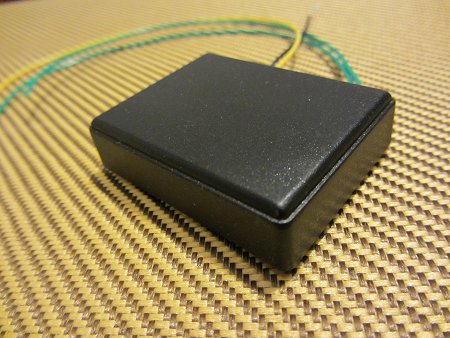
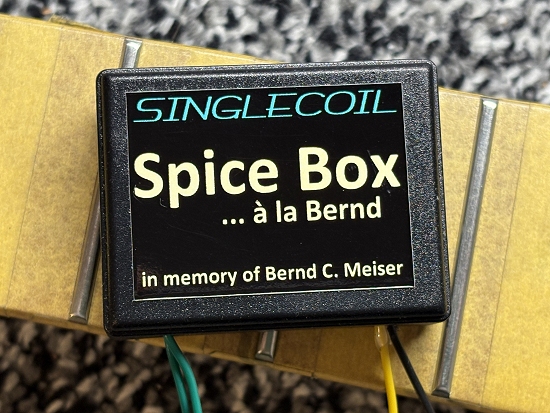
The Spice Box unit from the BSM company is a faithful but yet enhanced recreation of the famous MTC, developed by John "Dawk" Stillwell and used by Ritchie Blackmore through the 70’s and 80’s. After 1977, Ritchie’s Stratocaster was loaded with an additional passive filter device called MTC, featuring a treble bleed as well as a mid-control function. The BSM "Spice Box" is a faithful replica of the old MTC filter box, using modern selected parts because only the best is good enough. One feature of the BSM "Spice Box" is that when the volume control is rolled back, the tone gets clean with a tighter bass response, similar to an early 70’s stock Strat. Ritchie used this volume setting for soloing as well, especially when a soulful feeling was required. In order to get a sweet sound with this setting, the second feature of the BSM "Spice Box" was incorporated: the famous mid-filter, using a toroidal-coil with selected core. Compared to a standard tone control using a capacitor, the mid-filter creates more chime and high-end, resulting in a warm and sweet tone, but with a good portion of transparency to prevent it from getting muddy - one of the real secrets of the BSM "Spice Box" ! With the volume rolled down, Ritchie often used the MTC’s mid-filter function to sweeten up his tone when needed. To prevent that this effect gets to prominent, Ritchie never fully closed the tone controls, especially for the bridge pickup. When increasing the volume, he usually also opened the tone control as well, because he wanted the loud, fat and powerful tone in this mode, so attenuating the mids was obsolete. The Spice Box has the same size compared to the original MTC, so you can put it under the tone pots of most standard routed Stratocasters.
The BSM "Spice Box" was officially released at March 2017 but Bernd C. Meiser sadly died untimely in July 2024 after fighting cancer for a year. All "Spice Boxes" were made to order by him so there was no stock meaning that the unit was no longer available. So we took over and brought his "Spice Box" back to life. It’s now produced by us and we are the company with which Bernd C. Meiser from the BSM Company did the analysis and research of the original MTC modules back in 2013.
Under the hood the BSM Spice Box is sporting the exact same guts Bernd Meiser used that are mostly out of his legacy. The same 100% point-to-point production process without any PCB’s and pre-manufactured parts is used to build the "Spice Boxes" so there are absolute no differences to the units Bernd built. But we went one step further regarding tolerances and selecting parts and are now using capacitors with a tiny 1% tolerance and resistors with an even more tiny 0.1% tolerance. This ensures that all Spice Boxes are 100% identical regarding tone and performance. Because of building much more "Spice Boxes" in parallel in comparison to Bernds process we were able to lower the price of each unit noticeably from 189.00 Euros down to 149.00 Euros. The BSM "Spice Box" changed its name to "SINGLECOIL Spice Box ... à la Bernd" and will be available permanently from now on. We even use the original instruction paper that Bernd came up with including his hand drawn wiring scheme, supplemented by some drawings we added to the instruction papers.
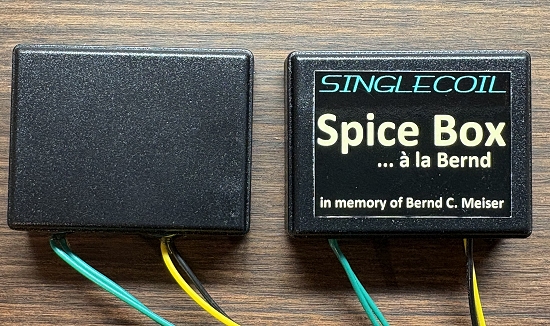
Working with resin to seal the boxes was a new challenge for everyone here and our first attempts ended up as blem ware with some resin on the case that you can’t remove. Technically they are perfect inside, but the case is optically not perfect. As long as stock lasts we sell the blem units for a very low price if you don’t care about optical appearance of the case ... it’s hidden under the pickguard anyway.
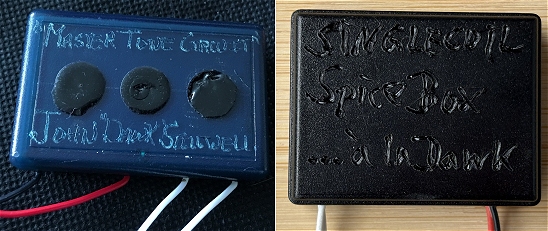
Some customers asked if it would be possible to order a Spice Box with the same color code for the wires and with the same "rustic" overall apperance like the original MTC - you asked for it, here it is: The Spice Box ... à la Dawk. We built a limited edition of 10 boxes and tried to mimic the original apperance of the MTC box from John "Dawk" Stillwell. Dawk obviously used his soldering iron to brand his boxes so we did the same. Under the hood it’s a 100% Spice Box ... à la Bernd using the same highly selected parts. It’s only a different color code for the wires and the branding mark instead of the sticker on the case - and it’s the same price. Only 10 boxes are made, no blem versions from this one available.
Price:
Our customers can download the detailed manual how to install and connect the BSM Spice Box H E R E You will need a password to open the file and we will only send it to verified customers - sorry, no exceptions !
Prices incl. VAT - packing, delivery and PayPal charges will be added additionally
SINGLECOIL "Line Driver/Buffer" systems
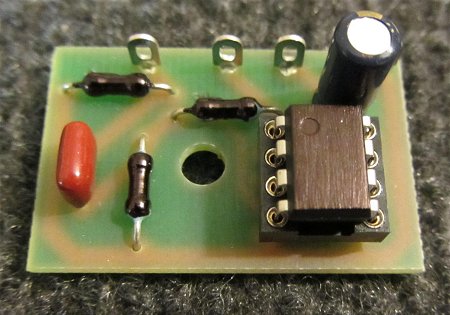
Your signal chain is everything between your guitar and the amplifiers input, including all the cables. As your signal chain gets more complex (adding more stompboxes and patch cables), more true-bypass devices or with the use of longer cables you may start to notice a loss of treble in your guitar sound. Your tone may sound much more lifeless and duller than it does when you plug your guitar straight into the amp with a short cable. You can avoid this problem with the use of a so-called "buffer" (aka "line driver") in front and/or after your signal chain. The general idea behind using a buffer in front of the signal path is to present a high impedance, low capacitance load to the guitar pickups, which lets all of the natural sound of the guitar come through without any degradation. The buffer also has a low impedance output that is easily capable of driving long cables and capacitive loads as seen in most pedalboards. You can also use such a device at the end of your fx-chain, to provide a rock-solid and strong signal for long cable runs to your amp(s). Our buffer boards are fully populated with the finest low-tolerance parts available, tested for functionality and tone and are ready to drop in, for full flexibility you can connect any wire to the solder lugs on the PCB you want to, to tweak the system even more - we recommend to use our audiophile silver/gold wire for this purpose ! You can build them into a stompbox, true bypass strip, a guitar, a bass ... whatever you prefer. We only use selected parts, the finest of the finest eg. selected high-quality IC’s and transistors, precision IC and transistor sockets, metal film resistors and film caps, so you will have no tolerances and background noise. You can power with 9 up to 18 volts for maximum headroom.
You can decide between three different versions, the "IC version" with absolutely no tone-coloration at all, the "Discreet version" with a transistor (JFET), that will slightly color your tone (but in a very positive, musical way, adding dynamics and transparency) or the "High Defintion" version with an ultra-high input impedance for bringing out unheard details.
The "Discreet version" with the JFET inside has no unity gain and it’s running at approx. 93% of the original signal. This is part of the design, and unavoidable ... the nature of the beast if you will. The JFET design will color your tone slightly, but in a very positive and musical way, making your tone fatter, warmer, rounder and adding dynamics and transparency. This version is ideal for use with all kinds of bases and a lot of Jazz and Swing players also prefer this one.
The "Standard version" is absolutely unity gain, so there is no volume difference between the unbuffered and the buffered signal. The Standard version is designed for absolutely no tone-coloration at all, it will not add any highs or cut any bass frequencies, it’s just as if it’s not there, simply taking care for a strong signal. This is the overall version for all kinds of applications and our best-selling version. This version also works perfectly at the end of your fx-chain as a line-driver for long cable runs to your amp(s).
The "High Defintion version" is a very special thing, it’s based on the IC version, so it has unity-gain and no tone colloration at all. But it provides an ultra-high input impedance (approx. four times the input impedance of the standard IC version), so it brings out previously inaudible and unheard details and richness of your tone. You will be suprised, how well defined and strong your tone will be, especially together with a good tube amp - your overall tone will be better, stronger and clearer than ever before. This version is also perfect for all acoustic instruments like guitars, violins etc.
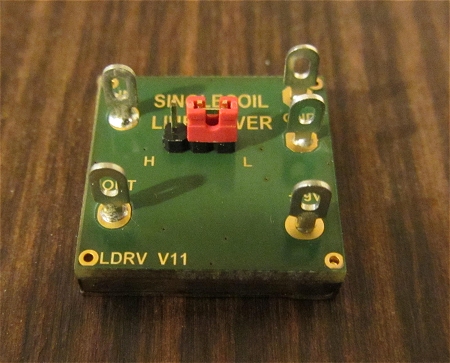
The "HD onoard version" is a top of the line fully shielded onboard module using high-quality Aerospace Grade SMD parts. This module is only 20x20mm and can be installed in the most tiny place you can imagine. This version is sporting a jumper where you can dial in two different output impedances ... kind of Discreet and HD version in one package. Naturally you can substitute the jumper with a switch so you can flip from one output impedance to another. The modules are fully shielded using a metal cover and for an easy installation we used solder lugs. This module is designed for installing it directly into a guitar or a bass but can also be put into an external stompbox.
So it’s all up to your choice. Custom versions of the buffer (eg. built into a stompbox, stand-alone units with true bypass etc.) are available from our Custom Shop, please send us an email with your wishes.
If you would like to try this buffer circuit before you build or buy one, no problem! We have built several buffer units, you can rent for free. All you have to do, is send us a deposit and your address. After you sent back the unit, you will receive a full refund of the deposit, minus the shipping costs.
If you want to read some official reviews of our buffer, Harmony Central is a good place to have a look at H E R E you can go directly to the HC overview page.
Prices:
Our customers can download the detailed manual how to install and connect the buffer H E R E You will need a password to open the file and we will only send it to verified customers - sorry, no exceptions !
Prices incl. VAT - packing, delivery and PayPal charges will be added additionally
SINGLECOIL "HD Booster" onboard module
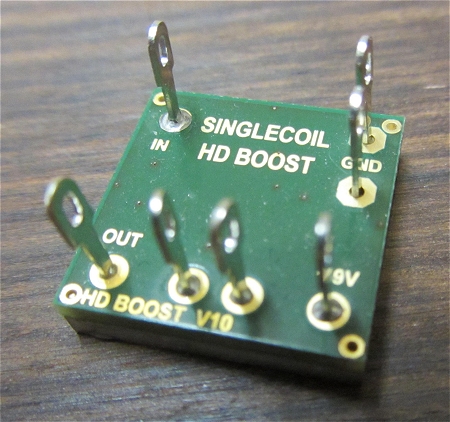
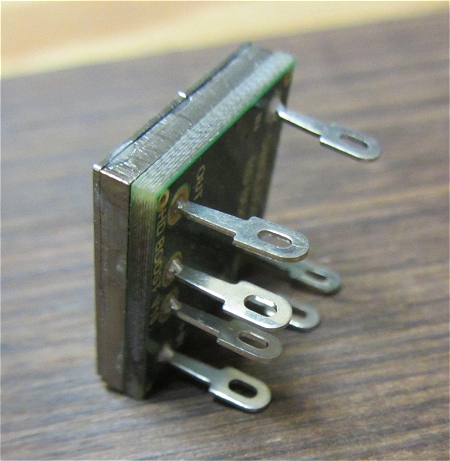
Our HD Booster is a top of the line fully shielded onboard module using high-quality Aerospace Grade SMD parts. This module is only 20x20mm and can be installed in the most tiny place you can imagine so you do not have to struggle any longer with routing additional compartments to install a booster into your guitar. Naturally you can also use this module to put it into an external enclosure for a very versatile booster stompbox. The booster has a gain range from 0 (= unity gain) up to 20.8 dB at full tilt. It can be powered with 9-18 volts and is sporting an excellent signal-to-noise ratio that can be described as virtaully noiseless. The module is fully shielded using a metal cover and for an easy wiring we used solder lugs.
Price:
Our customers can download the detailed manual how to install and connect the SINGLECOIL HD Booster onboard module H E R E You will need a password to open the file and we will only send it to verified customers - sorry, no exceptions !
Prices incl. VAT - packing, delivery and PayPal charges will be added additionally
SINGLECOIL "Wall of Sound" onboard modules
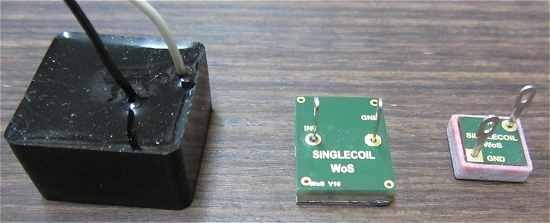
The "Wall of Sound" (WoS) is an onboard module for electric guitars to emulate an overdriven "stadium tone", known from e.g. Brian May when playing through his whole wall of VOX AC-30 amps. The passive WoS module does basically two things: pre-clipping of the signal plus adding a smart frequency correction. The WoS is working in a pure passive way and does not need any batteries. The WoS is NOT designed as an onboard overdrive like the "Black Ice" and it can’t substitute your external overdrive or distortion pedal - when playing the WoS signal into a clean amp it will sound, let’s say, a little bit wired. The WoS is designed to work together with your external overdrive pedals and when you activate it, it will make your overdriven signal much bigger and more focused. It works great with all overdrive and distortion pedals but does not sound very good together with a fuzz pedal. It’s a simple installation process, you need a switch to activate the module, any on/off switch or push-pull pot will do.
Price:
Our customers can download the detailed manual how to install and connect the SINGLECOIL "Wall of sound" onboard module H E R E You will need a password to open the file and we will only send it to verified customers - sorry, no exceptions !
Prices incl. VAT - packing, delivery and PayPal charges will be added additionally
|